Banking, Camber and the Shape of a Corner
Learn how banking and camber differ by identifying a corner’s inside and outside edges, then read the slope and understand what the track’s shape shows.
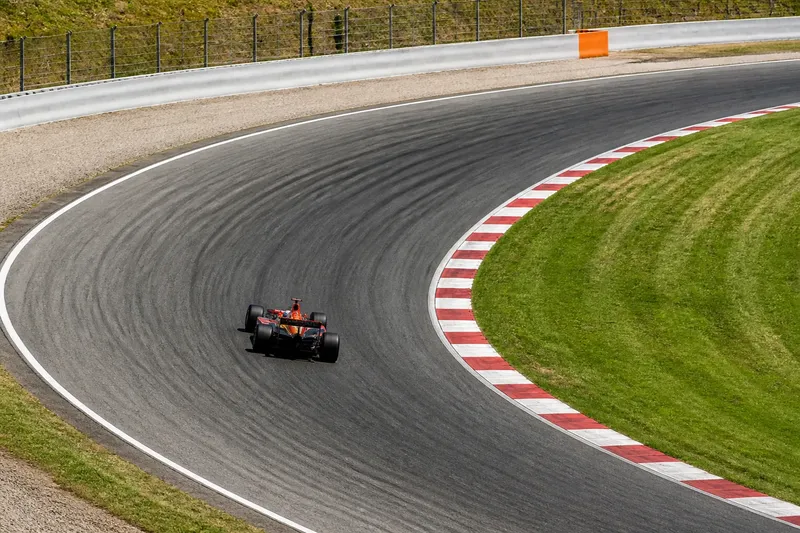
At an oval turn, the outer edge of the track can sit visibly higher than the inner edge. That cross-slope is banking; on road courses, the same basic tilt is often described as positive camber. Knowing which edge is higher helps spectators read the corner without mistaking its shape for the car’s lean.
Banking describes the turn’s built-in slope
To judge a corner, first establish the direction a car travels through it. The inside edge is nearer the centre of the turn; the outside edge is farther away. If the track rises from the inside edge to the outside edge, the surface is banked towards the outside.
That slope changes the direction of the road’s support beneath the tyres. Part of the support points towards the turn’s centre, helping oppose the outward effect of the car changing direction. The tyres still need to interact with the surface, and banking alone does not determine how a car will behave.
Banking is often used for a pronounced or sustained slope through a turn, as on an oval. A road-course corner can also be banked, and the slope may ease or change as the car travels from entry to exit.
Camber names the cross-slope relative to the corner
Camber describes how the road tilts across its width. In corner descriptions, positive camber means the outside edge is higher than the inside edge; negative camber means the outside edge is lower. These terms describe the track surface, not the angle of a car’s wheels.
Positive camber therefore slopes up towards the outside of the turn, broadly the same direction as banking. Negative camber slopes down towards the outside. The important distinction is that “banking” commonly refers to a pronounced, sustained turn profile, while “camber” is often used for the local cross-slope. The terms can overlap because both describe the track’s shape across its width.
Think of a shelf tilted across its width: its two edges make the direction of the slope easy to see. For a corner, though, you must first identify which edge is inside and which is outside; left and right on the screen are not reliable substitutes.
Read the surface by comparing its edges
A nearly level corner has little cross-slope from edge to edge. A positive cross-slope rises towards the outside, while a negative cross-slope falls towards it. A corner’s profile can also change along its length, so a single label may not describe every part of the turn equally well.
For a clear view, look for a camera angle that shows both edges of the track. A head-on shot can hide the cross-slope, while an elevated or oblique view can make the height difference easier to see. Use the road edges as your reference rather than inferring the surface angle from the car’s body, which may lean or pitch for other reasons.
- If the outside edge is higher than the inside edge, identify a positive cross-slope; if the edges appear level, look for a higher or more oblique view before calling it flat.
- If the outside edge is lower than the inside edge, identify a negative cross-slope; if the inside and outside are unclear, trace the car’s direction through the turn before judging.
- If the slope appears to continue through much of a turn, describe it as sustained banking; if it is confined to a local section, describe that section’s camber.
- If the cross-slope changes between entry and exit, describe the change rather than applying one label to the whole corner; if it remains consistent, state the direction of the slope.
- If one camera angle makes the surface seem level, compare it with a view showing both track edges; if no such view is available, treat the apparent slope as uncertain.
- If the car seems to lean, separate that visual cue from the road profile by checking the edges; if the edges show no clear tilt, do not use the car’s posture alone to classify the corner.
What do spectators need to know about banking and camber?
How can I tell positive camber from negative camber?
Look across the track and compare the edges relative to the direction of travel. An outside edge higher than the inside is positive camber; an outside edge lower than the inside is negative camber.
Is banking different from positive camber?
They describe overlapping features: both can involve a surface that rises towards the outside of a turn. “Banking” usually emphasises a pronounced or sustained turn slope, while “camber” often names the local cross-slope.
Does a banked corner remove the need for tyre grip?
No. The tyres still interact with the track as the car turns. Banking changes the direction of the road’s support, but it does not make tyre interaction irrelevant.
Why can a corner look flat from one camera angle?
A view looking along the track may conceal the difference in height between its edges. An elevated or oblique view that shows both edges gives a better basis for judging the cross-slope.
Work through a camera-view comparison
Say a broadcast shot makes a right-hand corner look level. In this invented situation, the starting point is one low camera view with the track edges hard to compare. You switch to an elevated view that shows both edges, follow the car’s direction through the turn, and see that the outside edge is higher than the inside across the bend. The resulting description is a positive cross-slope; if that slope continues through much of the turn, “banking” is also a reasonable description. The second view clarifies the road profile, but it does not establish how every car will respond.
For a quick reading of banking and camber, establish the turn’s inside and outside, compare their heights, and check whether the slope persists or changes along the corner. If the view does not reveal both edges, keep the classification tentative rather than relying on the car’s apparent lean.