The First Race on a New Circuit: A Spectator’s Viewing Plan
A spectator viewing plan for an unfamiliar circuit helps you choose a useful seat, follow clear landmarks and understand more of the race from one viewpoint.
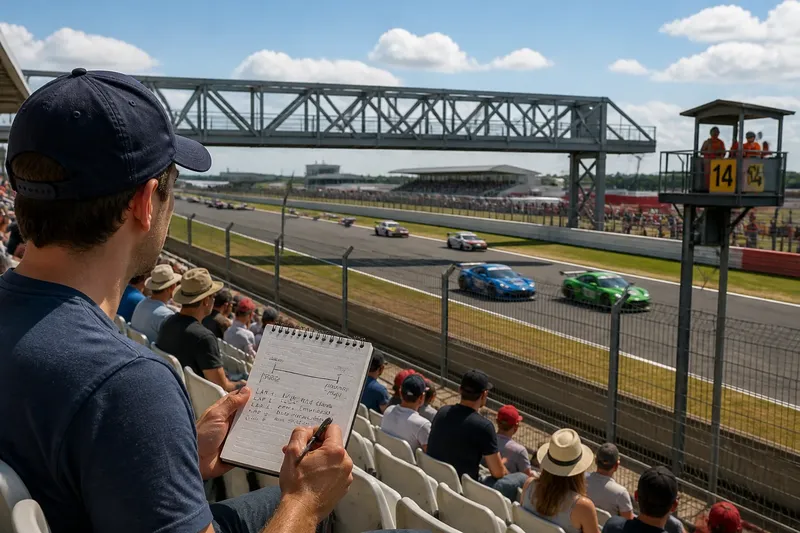
You settle into a seat at an unfamiliar circuit and the cars keep vanishing behind fencing before you can tell what changed. A spectator viewing plan helps you choose one clear section to follow, then use its landmarks to keep track of the order and movement you can actually see.
Start by deciding what you want your view to tell you. You might want to recognise changes in the running order, watch cars approach the pit lane or see how a group spreads out along a straight. The best viewpoint is the one that gives you a clear answer to that particular question.
Choose a viewpoint that suits your question
Check the circuit map and the venue’s spectator information before choosing a place. A map can show whether a stand faces a pit exit, a straight or a sequence of bends, but it cannot show every obstruction from your seat. On arrival, check for fencing, signs, trees, elevation changes and other features that could block the view.
A stand near the start or finish can help you follow the order of the field. A view near the pit lane may show cars entering or leaving the racing surface, while a long straight can make gaps between cars easy to compare. These viewpoints serve different purposes; none is automatically best for every spectator.
Look for more than one useful reference point in your chosen section. A marshal post, bridge, gantry or distinctive building can help you identify where a car is, while the edge of a grandstand or a change in fencing can mark where it disappears. If you can see a trackside screen, note where it is, but choose a view that remains useful without it.
Build a trackside map from fixed features
Use fixed landmarks to divide your visible section into parts. A distinctive building or bridge can mark one boundary; a marshal post or gantry can help you recognise another. Avoid temporary objects such as flags or parked vehicles, which may move or disappear.
Give each landmark a short name you can recognise quickly, such as “bridge” or “yellow marshal post”. Then note where your view begins and ends: perhaps the cars appear beside the post and disappear beyond a gap in the fence. This simple map helps you describe what you saw without needing to know the circuit’s official corner names.
Keep the limits of your view in mind. If cars disappear behind a building, you cannot directly see what happens there; commentary, timing information or a screen may offer context, but that is separate from your own observation. Treat the unseen part as a gap in the account rather than filling it with a guess.
Compare the same section on each lap
Repeated passes give you a chance to notice changes in the field. Choose one thing to watch, such as which car passes a fixed landmark first or whether two cars remain close together through the visible section. Comparing cars at the same point is more useful than comparing them at different stages of the lap.
Say you are watching an invented race from a stand beside a straight, with a bridge at one end and a marshal post at the other. At first, the blue car passes the bridge ahead of the green car; on a later lap, the green car reaches the bridge first. You can record that the order changed in your view, while leaving the cause open because it may have happened elsewhere on the circuit.
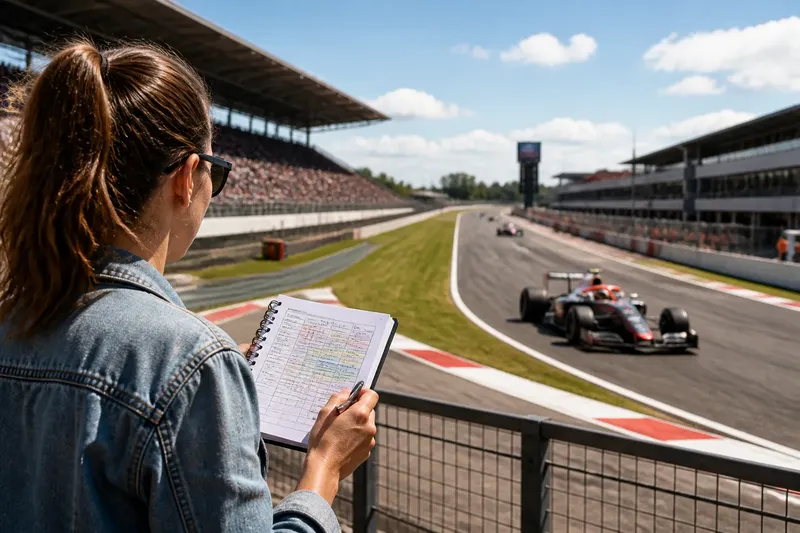
To keep notes clear, write down a car number or colour, the landmark and what you observed. “Blue car passed the bridge before the green car” is more precise than “the blue car lost ground”. If you are unsure which car you saw, note the uncertainty and check the timing display or commentary later.
Use maps, timing and screens to fill in context
An official circuit map can help connect your viewpoint to parts of the lap you cannot see. Find your spectator area on the map and note the nearest named section or turn, if one is given. This makes commentary easier to follow without requiring you to memorise the full layout.
Timing screens and broadcasts can provide broader context, such as the running order or a replay, depending on the event. Before looking away, decide what you want to check: perhaps whether the order changed or whether a car has entered the pit lane. Then return your attention to the live view.
The screen and the trackside view may show different moments or places. A broadcast can switch to another part of the circuit, and a timing display can update while the cars are elsewhere. Use each source for what it can tell you, and keep direct observations distinct from information supplied by the screen.
What should you check before settling in?
Which landmarks should you use?
Choose fixed features you can see clearly, such as a bridge, gantry or marshal post. If a feature is obscured from your seat, choose another one; the useful landmark is the one you can reliably recognise.
Is a stand or an open spectator bank more useful?
A stand may offer a more consistent view, while an open bank may provide a different angle; the actual sightline depends on the venue and your position. Check the event’s spectator information and choose the permitted area that gives you the clearest view of your chosen section.
What should you do when a car disappears?
Note the landmark where it leaves your view, then use the map, commentary or screen for context if needed. Keep that added information separate from what you saw directly and watch for the car when it returns to view.
When should you change viewing positions?
Move only if event rules allow it and you have a clear reason, such as a blocked sightline or a wish to watch a different part of the circuit. If your current view is clear, staying put helps you recognise the same landmarks on each pass.
Use a short checklist to prepare your view
- Access: Check the event’s spectator rules; if your intended area is open to you, plan around it, but if it is restricted, choose an authorised viewpoint instead.
- Sightline: Look for fencing, signs or trees across the track; if they block the section you want to watch, select another permitted seat or adjust your focus to the visible part.
- Landmarks: Identify fixed features you can see clearly; if a landmark is hard to distinguish, replace it with a bridge, gantry or other recognisable feature.
- View boundaries: Note where cars first appear and disappear; if a key part of the action is hidden, avoid treating it as something you witnessed and use a screen or commentary for context.
- Map: Locate your area on the official circuit map; if the map names a nearby section, use that name when following commentary, but if not, make a brief note of your own location.
- Screen: Check whether a timing display or broadcast is visible; if it can answer a specific question, consult it briefly, but if not, keep your attention on the live section.
- Observation: Choose one feature to follow, such as the order at a landmark; if it is easy to see, compare it on later passes, but if traffic obscures it, wait for a clearer moment.
Imagine you arrive at a permitted spectator bank beside a straight, with a bridge visible at one end and a marshal post halfway along. The event map places your bank beside the circuit’s north section, but a sign blocks part of the far end. You choose the bridge and marshal post as landmarks, decide to note which car passes the post first, and use the screen only if a car disappears behind the sign. The result is a clear record of the order you saw at the post, while the hidden section remains an acknowledged gap rather than a guessed story.
Before the race begins, check the venue’s current access guidance and follow staff directions. If movement is restricted or seating is allocated, plan around the place you are permitted to use. A well-chosen spectator viewing plan is not about seeing the whole circuit; it is about knowing exactly what your view can tell you, and keeping that observation distinct from the rest of the race.